
The Cybersecurity Career Path: From Security+ to CISSP

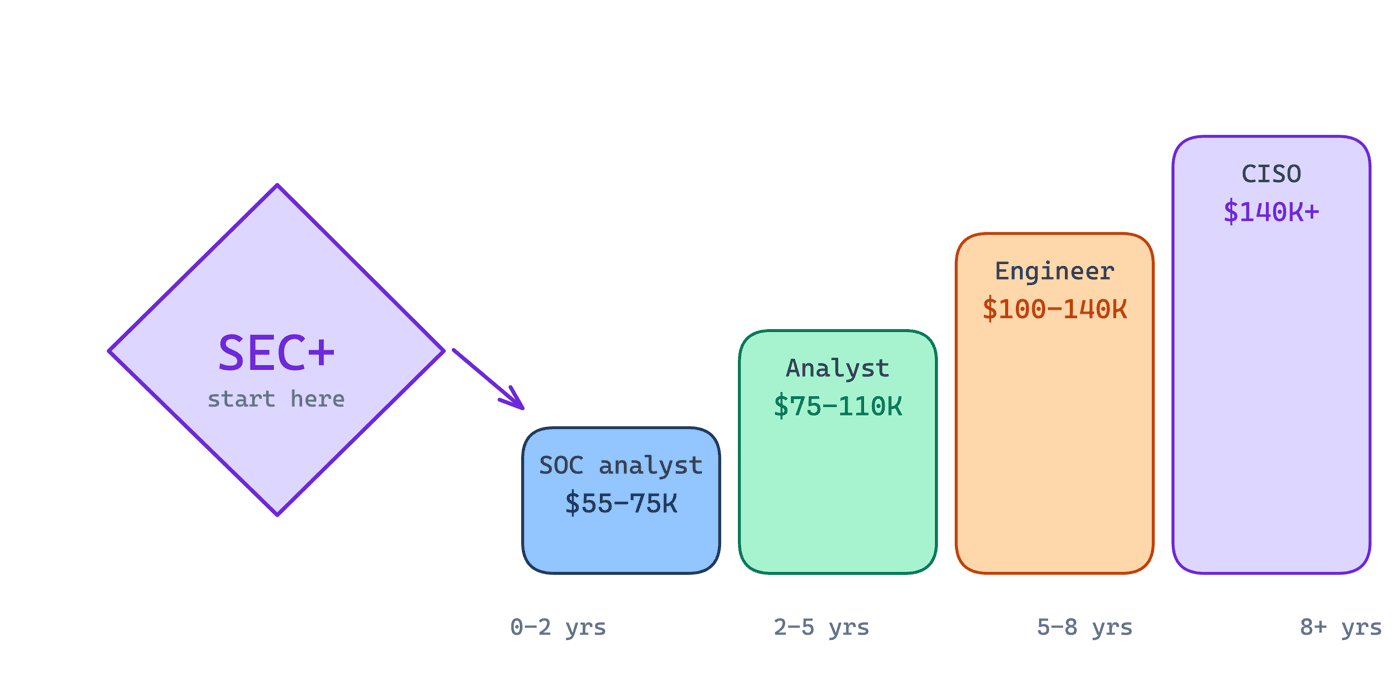
Cybersecurity is one of the fastest-growing and highest-paying fields in IT. Canada alone has an estimated 25,000+ unfilled cybersecurity positions, and the global shortage exceeds 3.5 million. If you're considering a career in cybersecurity, the opportunity is enormous, but the path requires strategic planning.
Here's how to map your career from entry-level to senior cybersecurity roles, with the certifications that matter at each stage.
The Cybersecurity Career Ladder
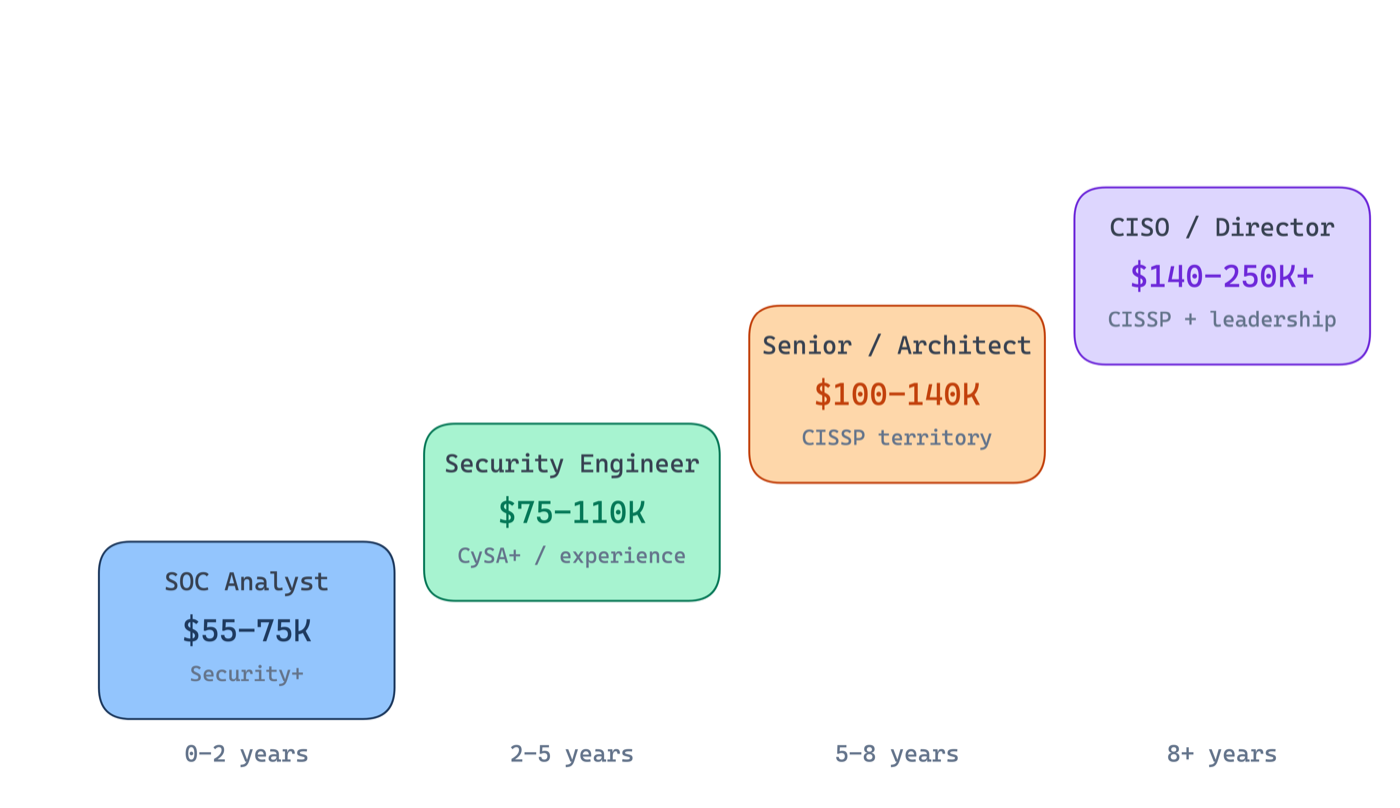
Level 1: Security Analyst / SOC Analyst (0-2 years) **Salary:** $55,000-$75,000 CAD **What you do:** Monitor security alerts, investigate incidents, write reports, and escalate threats. You're the first line of defense, watching dashboards and SIEM (Security Information and Event Management) tools for suspicious activity.
Required certifications:
• CompTIA Security+, The industry-standard entry point. Covers threat analysis, vulnerability management, identity management, and security operations. Required by the Canadian federal government and US Department of Defense for many security roles.
• CompTIA Network+ or CCNA (recommended), You need to understand networking to understand network security.
Key skills: Log analysis, SIEM tools (Splunk, QRadar, Sentinel), basic scripting (Python, Bash), incident documentation, threat intelligence fundamentals.
Level 2: Security Engineer / Incident Responder (2-5 years) **Salary:** $75,000-$110,000 CAD **What you do:** Implement security controls, configure firewalls and IDS/IPS systems, respond to security incidents, conduct vulnerability assessments, and harden systems.
Recommended certifications:
• CompTIA CySA+ (Cybersecurity Analyst), Focuses on threat detection, analysis, and response using behavioral analytics.
• CompTIA PenTest+, If you're leaning toward offensive security (penetration testing).
• Cisco CyberOps Associate, If you're in a Cisco-heavy environment.
• GIAC certifications (GSEC, GCIH), Highly respected but expensive ($2,000+ USD per exam).
Key skills: Firewall configuration (Palo Alto, Fortinet, Cisco ASA), vulnerability scanning (Nessus, Qualys), penetration testing basics, incident response procedures, forensic analysis.
Level 3: Senior Security Engineer / Security Architect (5-8 years) **Salary:** $100,000-$140,000 CAD **What you do:** Design security architectures, develop security policies and standards, lead incident response teams, assess organizational risk, and make strategic security decisions.
Key certification:
• CISSP (Certified Information Systems Security Professional), The gold standard for senior security professionals. Requires 5 years of cumulative paid work experience in at least 2 of the 8 CISSP domains.
The CISSP is where your career takes a significant leap. It's not just a technical certification, it validates your ability to think strategically about security at an organizational level. CISSP holders are trusted to design, implement, and manage enterprise security programs.
Key skills: Security architecture design, risk assessment and management, compliance frameworks (SOC 2, ISO 27001, NIST), cloud security, vendor management, team leadership.
Level 4: CISO / Director of Security (8+ years) **Salary:** $140,000-$250,000+ CAD **What you do:** Lead the entire security organization, report to the C-suite and board, set security strategy, manage budgets, and oversee compliance.
Certifications: CISSP (expected), CISM (Certified Information Security Manager), or CCISO. At this level, experience and track record matter more than additional certifications.
The Security+ Deep Dive
Since Security+ is where most cybersecurity careers begin, let's look at what the current SY0-701 exam covers:
Domain 1: General Security Concepts (12%) Fundamentals of security, CIA triad, AAA, zero trust, physical security, and deception technologies (honeypots, honeynets).
Domain 2: Threats, Vulnerabilities, and Mitigations (22%) The largest domain. Covers threat actors (nation-states, hacktivists, insider threats), attack vectors (phishing, social engineering, supply chain), malware types, vulnerability types (injection, XSS, buffer overflow), and mitigation techniques.
Domain 3: Security Architecture (18%) Network security design, cloud security models (IaaS, PaaS, SaaS), secure protocols (TLS, IPsec, SSH), infrastructure concepts (load balancers, WAFs, reverse proxies), and data protection strategies.
Domain 4: Security Operations (28%) The highest-weighted domain. Covers monitoring and alerting, incident response, digital forensics, vulnerability management, identity and access management, and automation/orchestration (SOAR).
Domain 5: Security Program Management and Oversight (20%) Governance, risk management, compliance, security policies, audits, security awareness training, and third-party risk management.
The exam is 90 minutes with up to 90 questions (mix of multiple choice and performance-based). The passing score is 750 out of 900.
Building a Home Security Lab
You can practice cybersecurity skills at home for free:
- Install VirtualBox or VMware and set up a virtual network with multiple VMs.
- Deploy Kali Linux, the standard penetration testing distribution. Practice using tools like Nmap, Wireshark, Metasploit, and Burp Suite.
- Set up a SIEM, Elastic Security (formerly ELK Stack) is free and open source. Configure it to collect logs from your VMs.
- Practice on vulnerable machines, TryHackMe and Hack The Box offer guided cybersecurity challenges ranging from beginner to advanced.
- Study real-world breaches, Read incident reports from Mandiant, CrowdStrike, and the CISA advisories. Understanding how real attacks work is invaluable.
Cybersecurity Job Market in Canada (2026)
The Canadian cybersecurity job market is exceptionally strong:
- Federal government is actively hiring security analysts and requires Security+ (or equivalent) for most positions.
- Banks (TD, RBC, BMO, Scotiabank) have massive security teams in Toronto and are constantly recruiting.
- Consulting firms (Deloitte, KPMG, EY, PwC) have dedicated cybersecurity practices hiring at all levels.
- Insurance companies are building security teams to meet regulatory requirements.
- Healthcare organizations are investing heavily in security following high-profile ransomware attacks.
Remote work is common in cybersecurity, especially for SOC analyst and security engineering roles. Many US companies hire Canadian security professionals as remote workers, paying USD salaries, a significant financial advantage.
The CISSP Path
The CISSP requires 5 years of professional experience, but you can take the exam earlier and become an "Associate of (ISC)²" while you accumulate the required experience. The 8 CISSP domains are:
- Security and Risk Management
- Asset Security
- Security Architecture and Engineering
- Communication and Network Security
- Identity and Access Management (IAM)
- Security Assessment and Testing
- Security Operations
- Software Development Security
CISNET's CISSP preparation course is 80 hours of instructor-led training with Sanjay, who holds the CISSP and has 12+ years of enterprise security experience. The course uses case-study-driven teaching to prepare you for the scenario-based questions that make the CISSP exam uniquely challenging.
Getting Started
The cybersecurity career path rewards persistence, curiosity, and continuous learning. The threats evolve constantly, which means the job is never boring, but it also means you can never stop growing.
Start with Security+, build your skills in a SOC or security engineering role, and work toward the CISSP when you're ready for senior leadership. The demand is there, the salaries are excellent, and the work genuinely matters.


