
CCNA v2.0 vs v1.1: What Changes on February 3, 2027

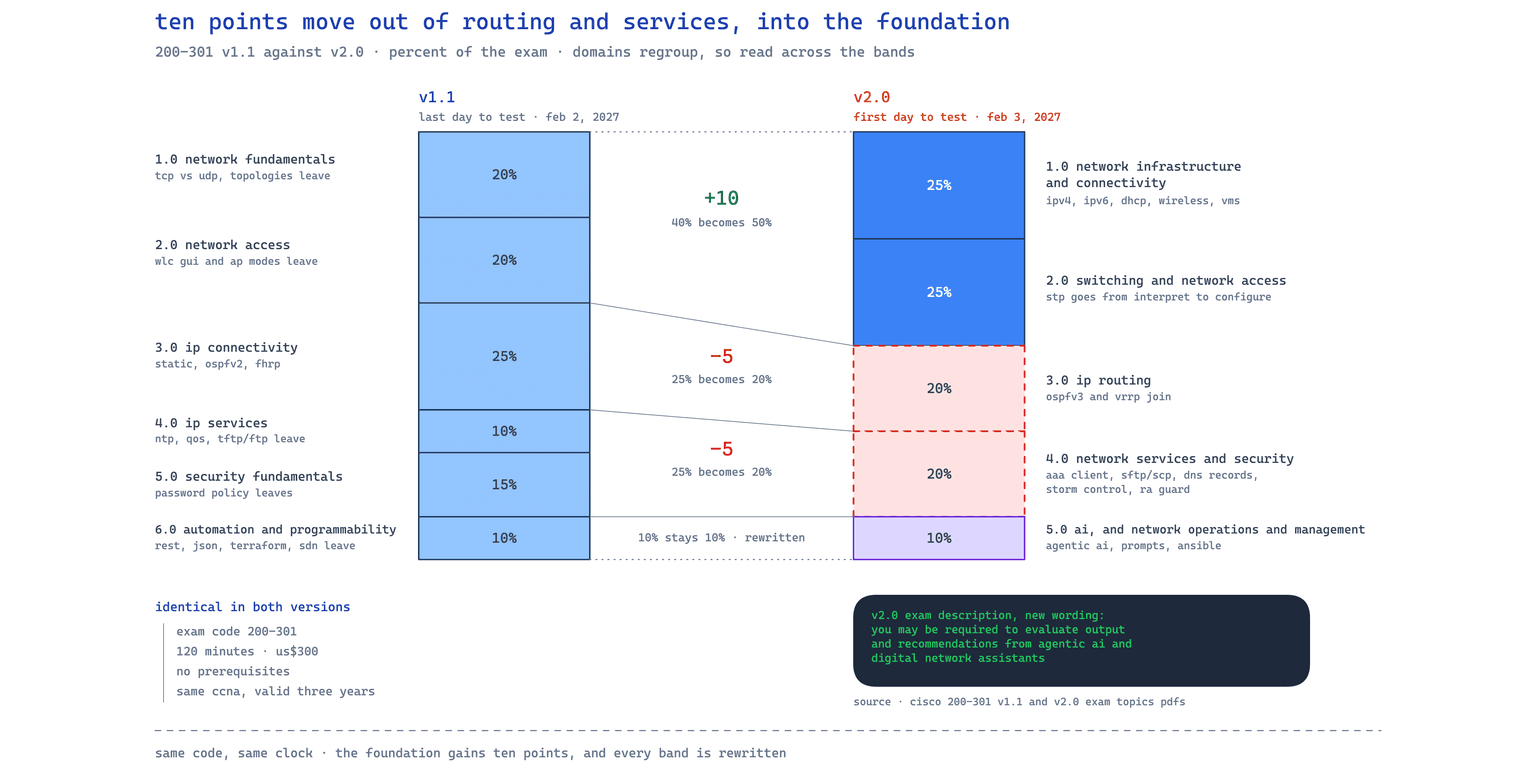
CCNA v2.0 is the new version of the Cisco 200-301 exam. The last day to test on the current version, v1.1, is February 2, 2027, and v2.0 goes live on February 3, 2027. The exam code stays 200-301, the exam stays 120 minutes and $300 USD, and a pass on either version earns the same CCNA certification, valid for three years.
What changes is what the exam asks you to do. Six domains become five, the topic list shrinks from 53 items to 29, and 8 of those 29 now open with "troubleshoot" or "diagnose", verbs that appear nowhere in v1.1. Cisco calls it "the first major CCNA blueprint change since 2019."
Verified October 9, 2026 against Cisco's 200-301 v1.1 and 200-301 v2.0 exam topics PDFs, read line by line against each other.
I am Mani Poopal, CCIE certified with more than twenty years in enterprise networking. I teach CCNA at CISNET. Every topic number on this page comes from Cisco's two PDFs, because several summaries circulating online list v1.1 topics as new.
CCNA v2.0 at a glance
| CCNA v1.1 | CCNA v2.0 | |
|---|---|---|
| Exam code | 200-301 | 200-301 |
| Can be taken | Through February 2, 2027 | From February 3, 2027 |
| Length | 120 minutes | 120 minutes |
| Price | $300 USD | $300 USD |
| Domains | 6 | 5 |
| Top-level exam topics | 53 | 29 |
| Topics that say troubleshoot or diagnose | 0 | 8 |
| Prerequisites | None | None |
The official v2.0 name is "Implementing and Administering Cisco Solutions (200-301 CCNA) v2.0". Cisco lists the question types as performance-based, multiple choice and drag-and-drop, and it does not publish the number of questions or the passing score for either version.
CCNA v1.1 vs v2.0 domain weights
| CCNA v2.0 domain | Weight |
|---|---|
| 1.0 Network Infrastructure and Connectivity | 25% |
| 2.0 Switching and Network Access | 25% |
| 3.0 IP Routing | 20% |
| 4.0 Network Services and Security | 20% |
| 5.0 AI, and Network Operations and Management | 10% |
| CCNA v1.1 domain | Weight |
|---|---|
| 1.0 Network Fundamentals | 20% |
| 2.0 Network Access | 20% |
| 3.0 IP Connectivity | 25% |
| 4.0 IP Services | 10% |
| 5.0 Security Fundamentals | 15% |
| 6.0 Automation and Programmability | 10% |
Cisco renamed and regrouped the domains, so comparing v1.1's domain 1.0 with v2.0's domain 1.0 misleads. Group them into bands instead:
| Band | v1.1 | v2.0 | Change |
|---|---|---|---|
| Cabling, addressing, switching: v1.1 1.0 and 2.0, v2.0 1.0 and 2.0 | 40% | 50% | +10 |
| Routing: v1.1 3.0, v2.0 3.0 | 25% | 20% | -5 |
| Services and security: v1.1 4.0 and 5.0, v2.0 4.0 | 25% | 20% | -5 |
| Automation and AI: v1.1 6.0, v2.0 5.0 | 10% | 10% | 0 |
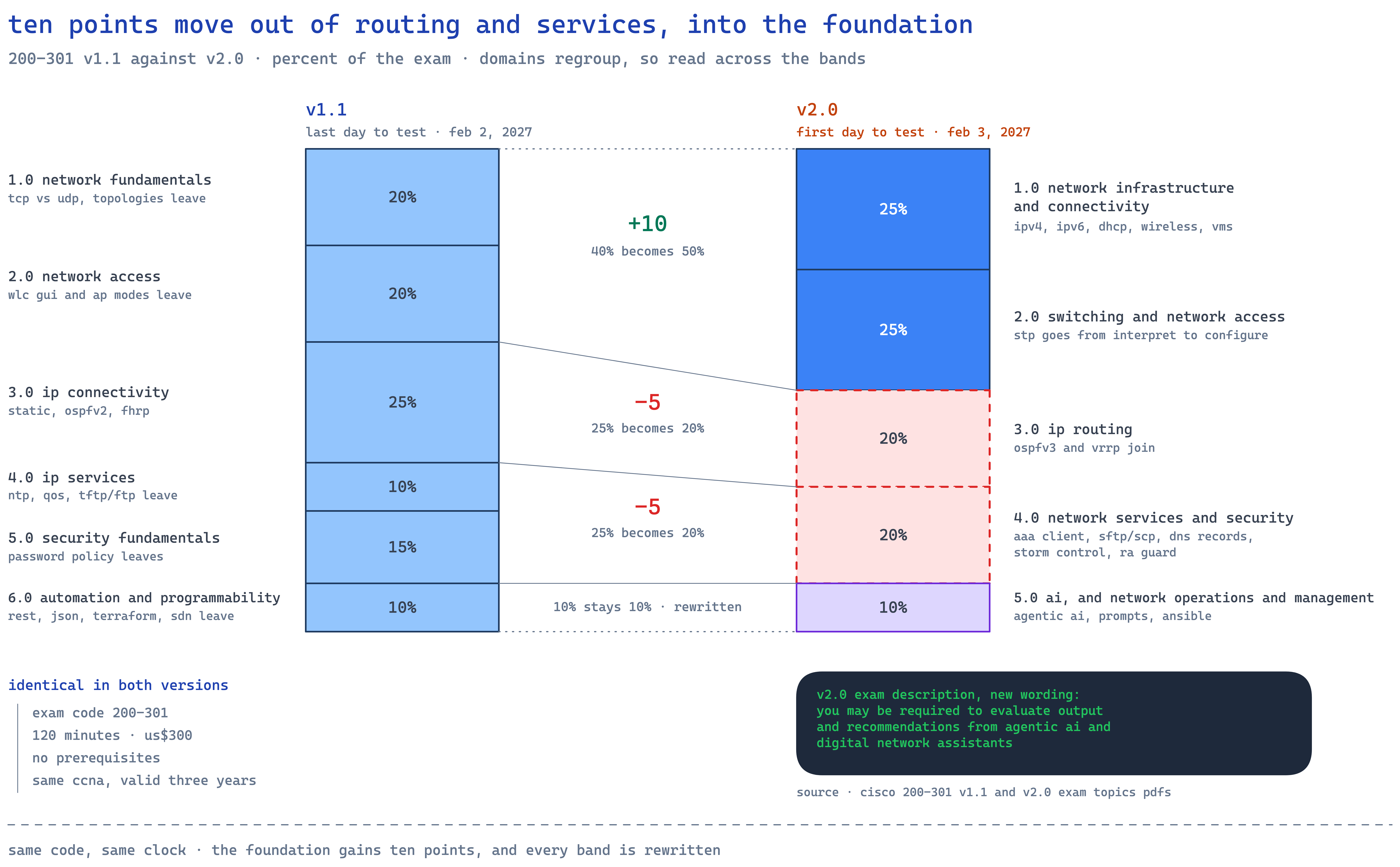
Half of v2.0 is now the foundation: physical faults, IPv4 and IPv6 addressing, DHCP, wireless, VLANs, trunks, EtherChannel and spanning tree. Routing still matters, but at 20% it is no longer the single biggest domain.
Several topics changed domains along the way. DHCP leaves IP Services and becomes topic 1.7, now including the server as well as client and relay. SNMP and syslog leave IP Services for domain 5.0, as 5.4 and 5.6. AAA, split across v1.1 topics 2.8 and 5.8, becomes one configuration topic, 4.1.
The biggest change is the verb, not the topic list
Cisco's announcement says a blueprint defines the exam's "scope and depth", and the depth lives in the verb. Count the verbs and the shift is stark: 33 of v1.1's 53 topics ask you to describe, explain, compare, define, recognize, identify or determine. In v2.0, only 6 of 29 do.
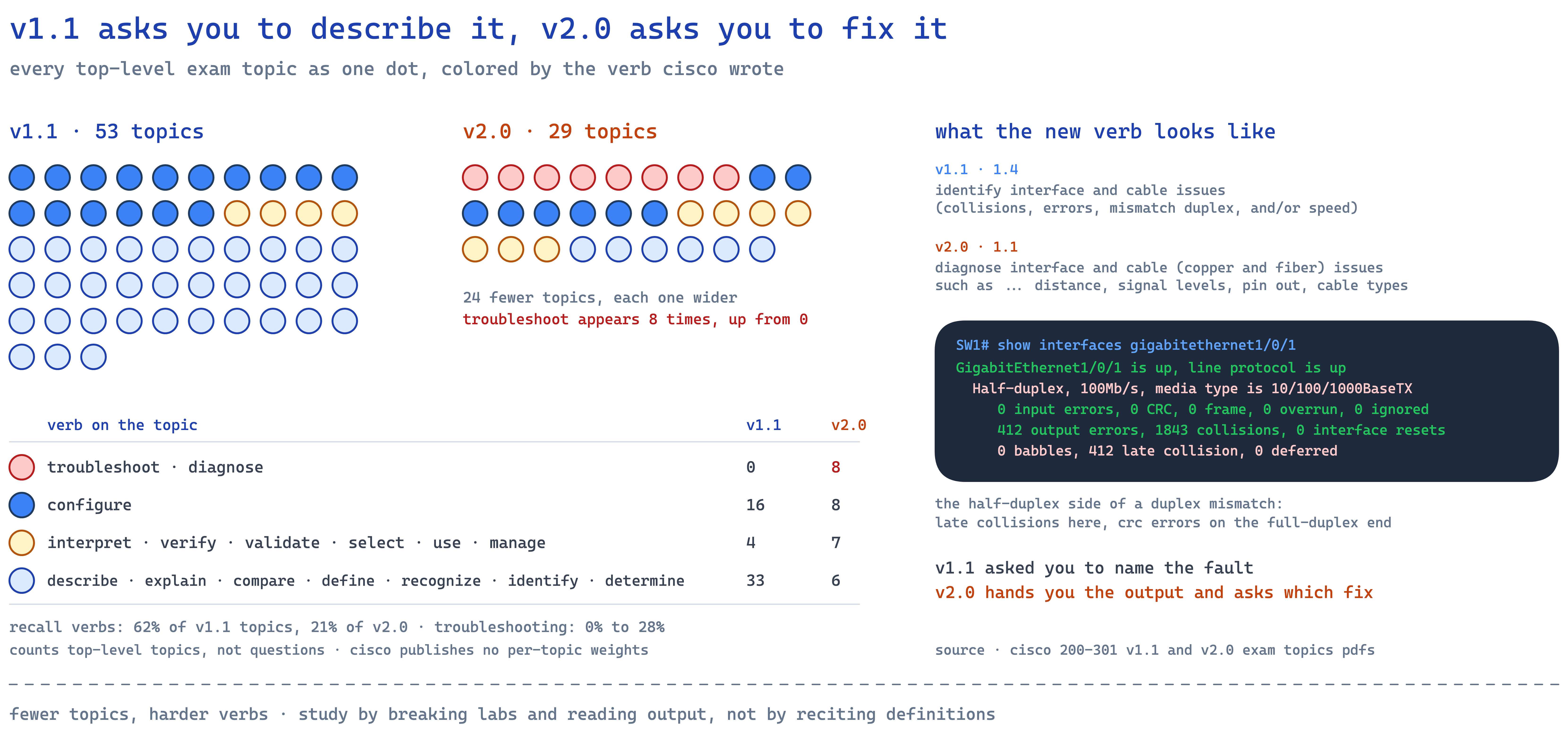
Here is how the same skill reads in each version:
| Skill | v1.1 topic | v2.0 topic |
|---|---|---|
| Interface and cable faults | 1.4 Identify | 1.1 Diagnose, now with copper and fiber, distance, signal levels and pin out |
| IPv4 addressing and subnetting | 1.6 Configure and verify | 1.3 Troubleshoot |
| IPv6 addressing | 1.8 Configure and verify | 1.4 Troubleshoot |
| Client IP settings | 1.10 Verify | 1.6 Troubleshoot wired and wireless clients on Windows, macOS and Linux |
| DHCP | 4.6 Configure and verify client and relay | 1.7 Troubleshoot client, server and relay |
| Static routing | 3.3 Configure and verify | 3.2 Troubleshoot |
| Rapid PVST+ | 2.5 Interpret | 2.5 Configure |
| First hop redundancy | 3.5 Describe | 3.4 Interpret the operational status of HSRP and VRRP |
| AAA | 5.8 Compare | 4.1 Configure as an AAA client with TACACS+ and RADIUS |
| DNS | 4.3 Explain the role | 4.4 Diagnose A, AAAA, CNAME, MX, NS and PTR records |
| Ansible | 6.6 Recognize | 5.5 Use to execute commands |
Cisco says the same thing in plainer words: the new exam "will test learners' practical skills." In practice that means reading show output and choosing the fix, rather than recalling a definition. A duplex mismatch, for example, used to be something you named. Now you get the interface counters and decide what is wrong.
What CCNA v2.0 adds
- AI in network operations, 5.1 and 5.2. Describe the role of agentic AI, and select a prompt for a generative AI system based on data classification, output format, persona and instructions. The exam description adds that you "may be required to evaluate output and recommendations from agentic AI and digital network assistants."
- Ansible you actually run, 5.5. v1.1 only asked you to recognize Ansible and Terraform. v2.0 asks you to use Ansible to execute commands.
- Infrastructure as code, 5.3. Network management approaches now span device-based, cloud-based, controller-based, automation-based and infrastructure as code.
- OSPFv3, 3.3. Single area OSPFv3 for IPv6 joins OSPFv2, with neighbor adjacencies "excluding authentication".
- VRRP, 3.4. Named next to HSRP.
- Secure device management, 4.1 and 4.2. Local usernames plus TACACS+ and RADIUS, and moving configuration and software files with SFTP and SCP.
- DNS records, 4.4. A, AAAA, CNAME, MX, NS and PTR, diagnosed for host, web and mail access.
- Two new Layer 2 security features, 4.7. Storm control and RA guard join DHCP snooping, dynamic ARP inspection and port security.
- A named troubleshooting toolkit, 2.4. Show commands "(including show logs)", ping, extended ping, traceroute and packet capture output.
- Edge ports, 2.2. VLAN, PoE, port channel and LACP settings for desktops, printers, IoT, access points, VoIP phones, virtualized hosts and network appliances.
- PAT by name, 4.3. NAT and PAT on IOS XE routers. v1.1 never said PAT.
Our subnetting guide covers the IPv4 math that topic 1.3 now asks you to troubleshoot.
What CCNA v2.0 removes
Each of these is in the v1.1 PDF and absent from v2.0:
- Comparing TCP to UDP, v1.1 topic 1.5.
- Topology architectures: two-tier, three-tier, spine-leaf, WAN, SOHO, on-premises and cloud, 1.2.
- Switching concepts as a standalone topic: MAC learning and aging, frame flooding and the MAC address table, 1.13.
- VRFs, and the anycast and multicast IPv6 address types.
- Cisco wireless architectures and AP modes, WLAN component connections, and WLC GUI configuration, 2.6, 2.7, 2.9 and 5.10.
- NTP, 4.2, and QoS per-hop behavior, 4.7.
- TFTP and FTP, 4.9, replaced by SFTP and SCP.
- Key security concepts, security program elements, and password policy including multifactor authentication and biometrics, 5.1, 5.2 and 5.4.
- SDN architecture: overlay, underlay, fabric, and northbound and southbound APIs, 6.3.
- REST APIs, 6.5, and JSON, 6.7.
- Terraform, and BPDU filter.
SSH configuration, v1.1 topic 4.8, is no longer its own topic, but SFTP and SCP run over SSH, so you still need it working.
One correction for your notes: some summaries list BPDU filter, VRFs and Terraform as new in v2.0. All three are v1.1 topics, and none of them appears in v2.0.
"Removed" does not mean useless before February. Every item above stays testable on v1.1 through February 2, 2027. Cisco also notes that "additional related topics may be included in any given exam version."
Should you take v1.1 now or wait for v2.0?
Cisco's own advice, from its July 2026 post: "Take the current CCNA v1.1 exam now." Hank Preston, a Cisco Distinguished Architect, says v2.0 "isn't a complete and total overhaul" but a different approach to the depth of each topic.
The calendar decides it for most people. From October 9, 2026 there are 116 days, about 16 weeks, until v1.1 closes. Cisco makes you wait five calendar days after a failed attempt, counted from the day after. To keep one retake in reserve, your first v1.1 attempt has to happen by January 27, 2027.
| Where you are today | What to book |
|---|---|
| Studied most of v1.1 and passing timed practice exams | v1.1, in December or early January, January 27 at the latest |
| About halfway through v1.1 material | v1.1 only if you can test by mid-January with a retake in reserve, otherwise switch to v2.0 now |
| Starting from zero | v2.0. Our CCNA study guide budgets 120 to 180 hours, and beginners usually need four to six months |
| Already certified and renewing | Either version renews it, or earn 30 continuing education credits |
Switching costs less than it looks. Subnetting, VLANs and trunking, Rapid PVST+, EtherChannel, static routing, OSPFv2, first hop redundancy, NAT, ACLs, IPsec VPN concepts, DHCP snooping, dynamic ARP inspection, port security, SNMP and syslog are in both blueprints. Cisco also says the free CCNA preview training on Cisco U. supports "both the existing CCNA v1.1 exam and the new CCNA 2.0 exam."
How to study for the new verbs
Troubleshooting is learned by breaking working networks, not by rereading notes. For every lab you build, break it on purpose and fix it from the output:
- Set one side of a link to half duplex and read the counters on both ends.
- Give a host the wrong mask or gateway, then work it out from the client with
ipconfig,ip addrorifconfig. - Remove an
ip helper-addressand trace why DHCP fails across the router. - Break an OSPF adjacency with a mismatched area or hello timer and read
show ip ospf neighbor. - Point a floating static route at the wrong next hop and follow
show ip route.
Packet Tracer handles most of this practice. Ansible is the exception: it needs a control node running Linux or macOS and devices that accept real SSH sessions, so use Cisco Modeling Labs or a couple of physical switches for topic 5.5. Our CCNA practice questions cover the topics both versions share.
What it costs to sit the CCNA in Canada
Cisco prices the exam at $300 USD and bills in US dollars. At the Bank of Canada rate of 1.4240 on October 8, 2026, that is about $427 CAD, before your card's foreign transaction fee and any sales tax at checkout. The price is the same for v1.1 and v2.0.
Pearson VUE delivers it at test centres across Ontario and the GTA, or online from home with a remote proctor through OnVUE. Pass or fail results usually appear online within 48 hours. Full exam facts sit on our CCNA certification page.
CISNET's CCNA course is 30 hours of live instructor-led training across 8 Saturdays, with subnetting, VLANs and trunking, OSPFv2 and OSPFv3, NAT and DHCP built as hands-on labs in Packet Tracer, at $499 CAD (reg. $699). The next cohort runs Saturdays from November 28, 2026 to January 30, 2027, three days before v2.0 goes live.
Sources and last verified
Verified October 9, 2026 against:
- Cisco 200-301 CCNA v2.0 exam topics PDF and the v2.0 exam topics page, for domains, topics, price, length and question types.
- Cisco 200-301 CCNA v1.1 exam topics PDF.
- Cisco's May 20, 2026 announcement, May 31, 2026 update and July 1, 2026 guidance, for the dates and Cisco's advice.
- Cisco exam policies, for the five-day retake wait.
- Bank of Canada exchange rates, for the CAD figure.
Topic and verb counts are my own tally of the two PDFs. Cisco does not publish weights for individual topics, so they measure the blueprint, not the share of questions. The exchange rate is the figure most likely to change.
Frequently Asked Questions
When does the new CCNA v2.0 exam start?
CCNA v2.0 goes live on February 3, 2027. The last day to take the current v1.1 exam is February 2, 2027. Cisco published the v2.0 exam topics on May 20, 2026, and the exam code stays 200-301 for both versions.
Is the CCNA exam code changing with v2.0?
No. Both versions are exam 200-301, and both earn the same CCNA certification. The official v2.0 title is "Implementing and Administering Cisco Solutions (200-301 CCNA) v2.0", still 120 minutes and $300 USD.
Will my CCNA be valid if I pass v1.1 before February 2027?
Yes. A v1.1 pass earns the same CCNA certification, valid for three years. You renew it by passing whichever CCNA version is current at the time or a higher level Cisco exam, or by earning 30 continuing education credits.
Should I wait for CCNA v2.0 or take v1.1 now?
If you can be ready by January 27, 2027, take v1.1: Cisco recommends it, and that date leaves room for one retake after the five-day wait. If you are starting from zero in autumn 2026, plan for v2.0, because the 120 to 180 hours most candidates need will not fit before February 2.
What is the AI domain on CCNA v2.0?
Domain 5.0, "AI, and Network Operations and Management", is 10% of the exam. Topics 5.1 and 5.2 cover the role of agentic AI and selecting a prompt for a generative AI system, considering data classification, output format, persona and instructions. Candidates may also have to evaluate output and recommendations from AI assistants. It replaces v1.1 topic 6.4, which only asked you to explain AI and machine learning.
What was removed from the CCNA in v2.0?
TCP versus UDP, topology architectures, switching concepts as a standalone topic, VRFs, AP modes and WLC GUI configuration, NTP, QoS, TFTP and FTP, password policy, SDN architecture, REST APIs, JSON, Terraform and BPDU filter. All of them stay testable on v1.1 until February 2, 2027.
Is CCNA v2.0 harder than v1.1?
It is narrower but deeper. The topic count falls from 53 to 29, but 8 of the 29 ask you to troubleshoot or diagnose, against none in v1.1, and recall-style topics fall from 62% of the list to 21%. Candidates who learn by labbing and reading output will find it fairer; candidates who memorize definitions will find it harder.


