
Security+ SY0-701 Study Guide: Pass in 8 Weeks (2026)

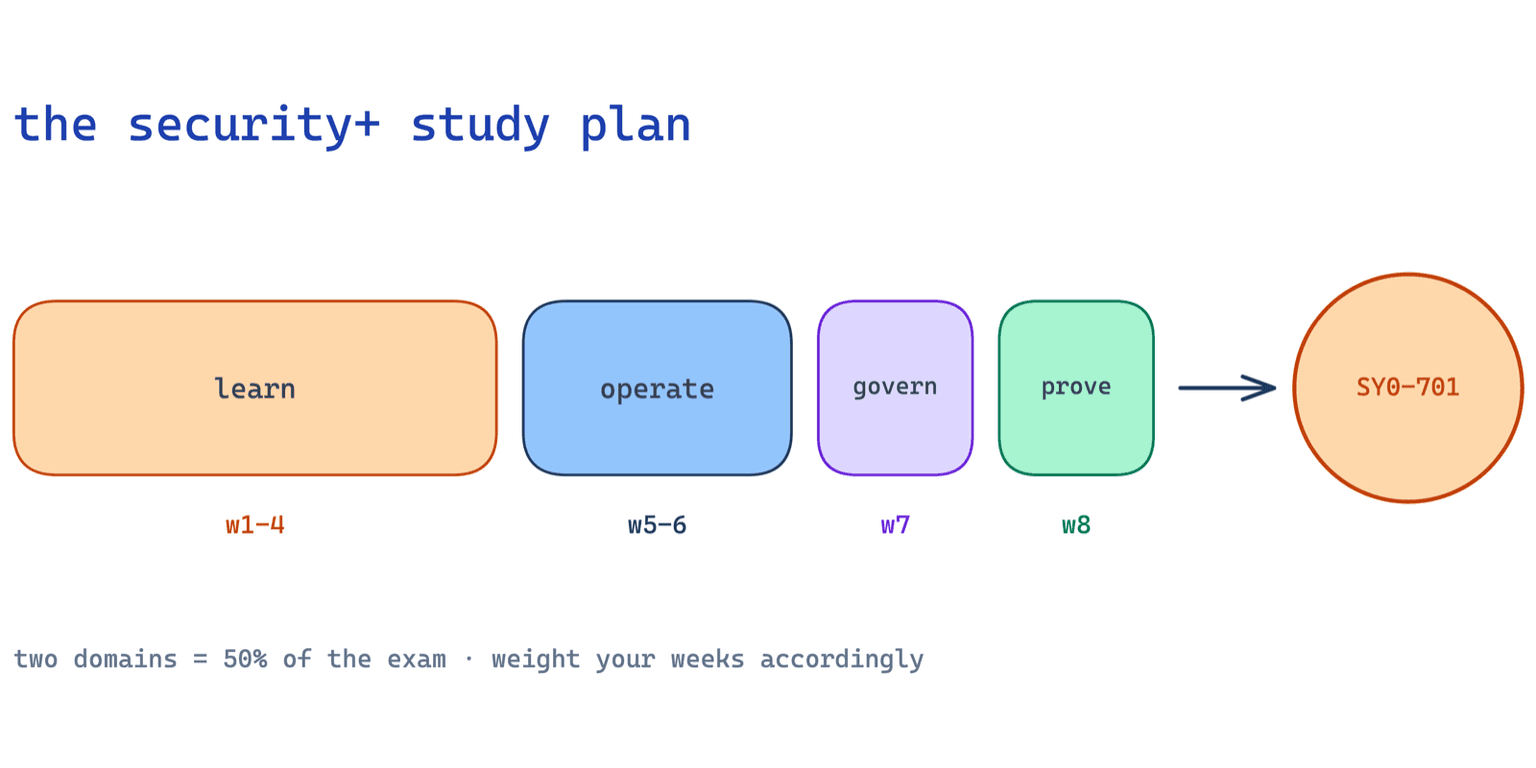
CompTIA Security+ is the certification Canadian SOC and security analyst postings ask for by name, and SY0-701 is the version you will sit today. It is also the exam where preparation strategy matters most: five domains with very different weights, a wall of acronyms, and performance-based questions that punish anyone who only read a textbook.
At CISNET, our lead instructor Mani has spent 15+ years teaching networking and security fundamentals, and the students who pass on the first attempt share one habit: they study each domain in proportion to its exam weight instead of giving every chapter equal time. This guide gives you that plan, an 8-week schedule, and the exam-day tactics that protect your score.
What the SY0-701 Exam Covers
Security+ tests five domains, and they are far from equal:
- General Security Concepts (12%), control categories and types, the CIA triad, zero trust, change management, and cryptography fundamentals including PKI.
- Threats, Vulnerabilities, and Mitigations (22%), threat actors, social engineering, malware types, application and network attacks, and the mitigations that stop them.
- Security Architecture (18%), secure network design, segmentation, cloud and virtualization security, and protecting data at rest and in transit.
- Security Operations (28%), the largest domain: system hardening, monitoring, log analysis and SIEM, identity and access management, and incident response.
- Security Program Management and Oversight (20%), governance, risk management, compliance, audits, and awareness training.
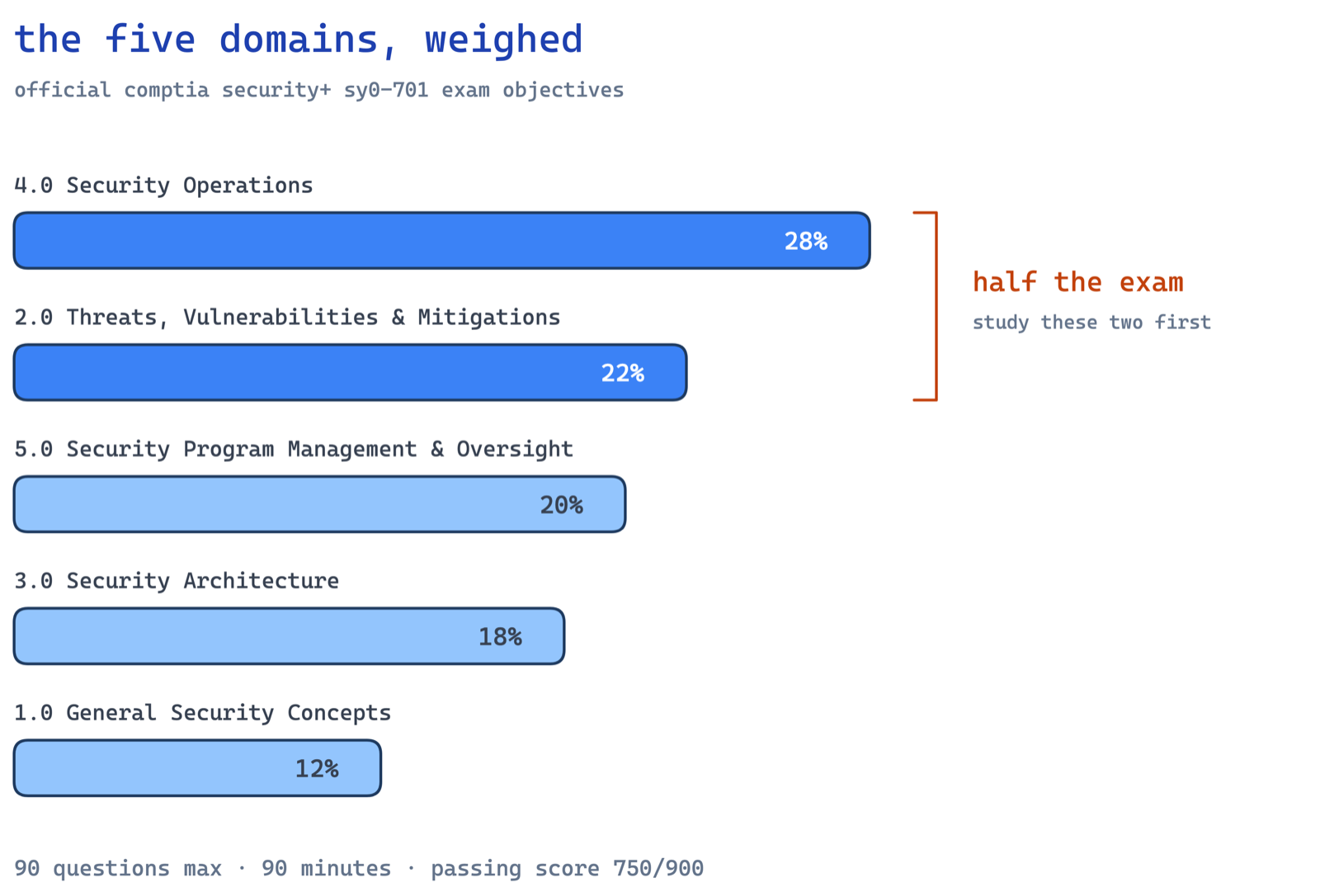
The mechanics: up to 90 questions in 90 minutes, a mix of multiple-choice and performance-based questions (PBQs), scored on a 100-900 scale with 750 needed to pass. The exam voucher costs USD $404, and the certification is valid for three years. Full logistics are on our Security+ certification page.
Look at the diagram again before you build a study schedule. Security Operations and Threats together are half the exam. If your prep time does not reflect that, you are studying for a different test.
Start With Controls: The Concept Everything Builds On
Domain 1 is the smallest, but one concept inside it shows up in questions from every other domain: security controls. Every control has a category (who or what implements it) and one or more types (what it does to risk).
The four categories are technical (implemented by systems), managerial (implemented by policy and planning), operational (implemented by people and processes), and physical (implemented by things you can touch). SY0-701 lists six types: preventive, deterrent, detective, and corrective are the four you will see most, with compensating and directive rounding out the list.
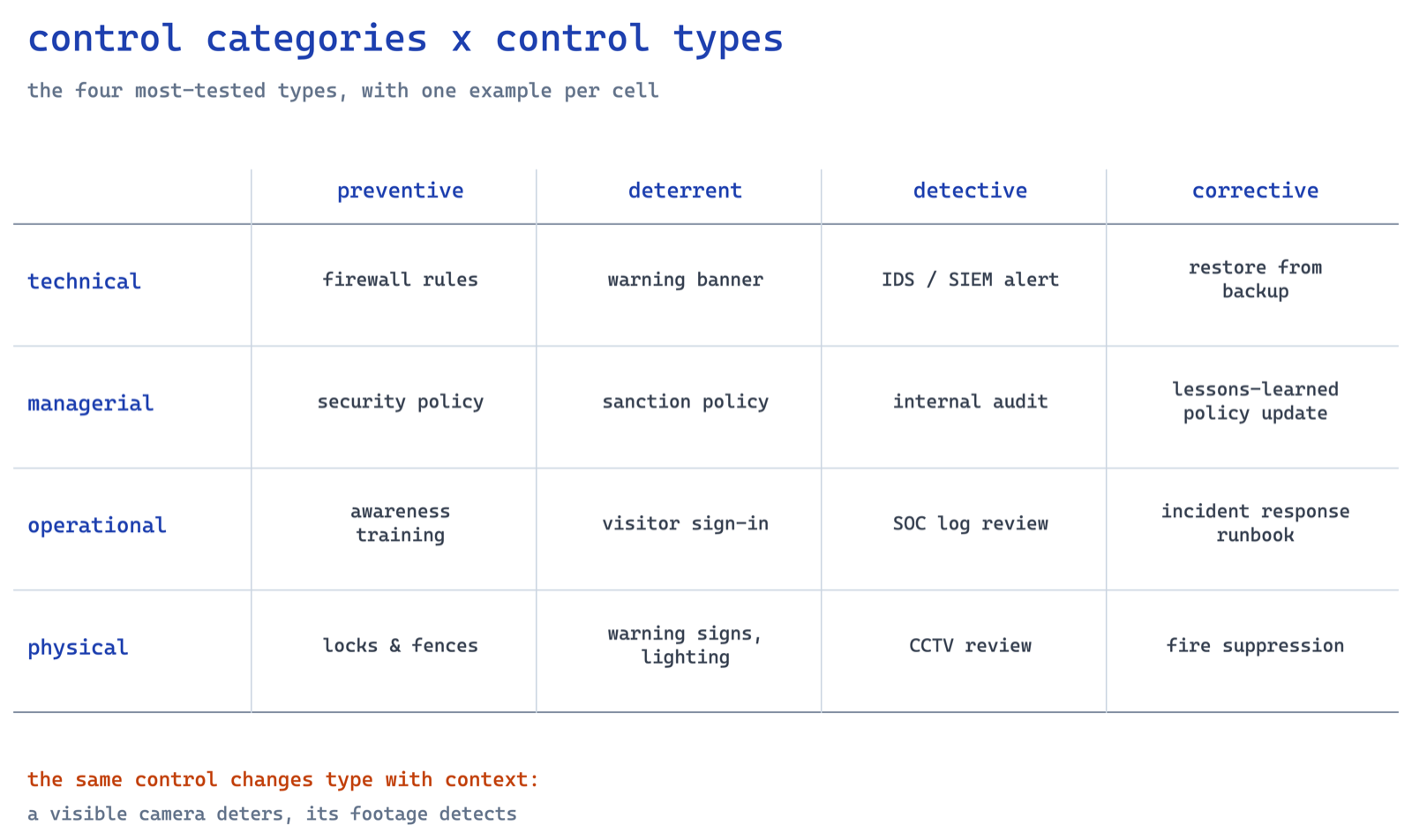
The exam trick to internalize: the same control changes type with context. A visible camera deters; reviewing its footage detects. A backup is corrective the moment you restore from it. Questions ask for the BEST classification in a scenario, so always ask what the control is doing to risk in that sentence, not what the object is.
The 8-Week Study Plan
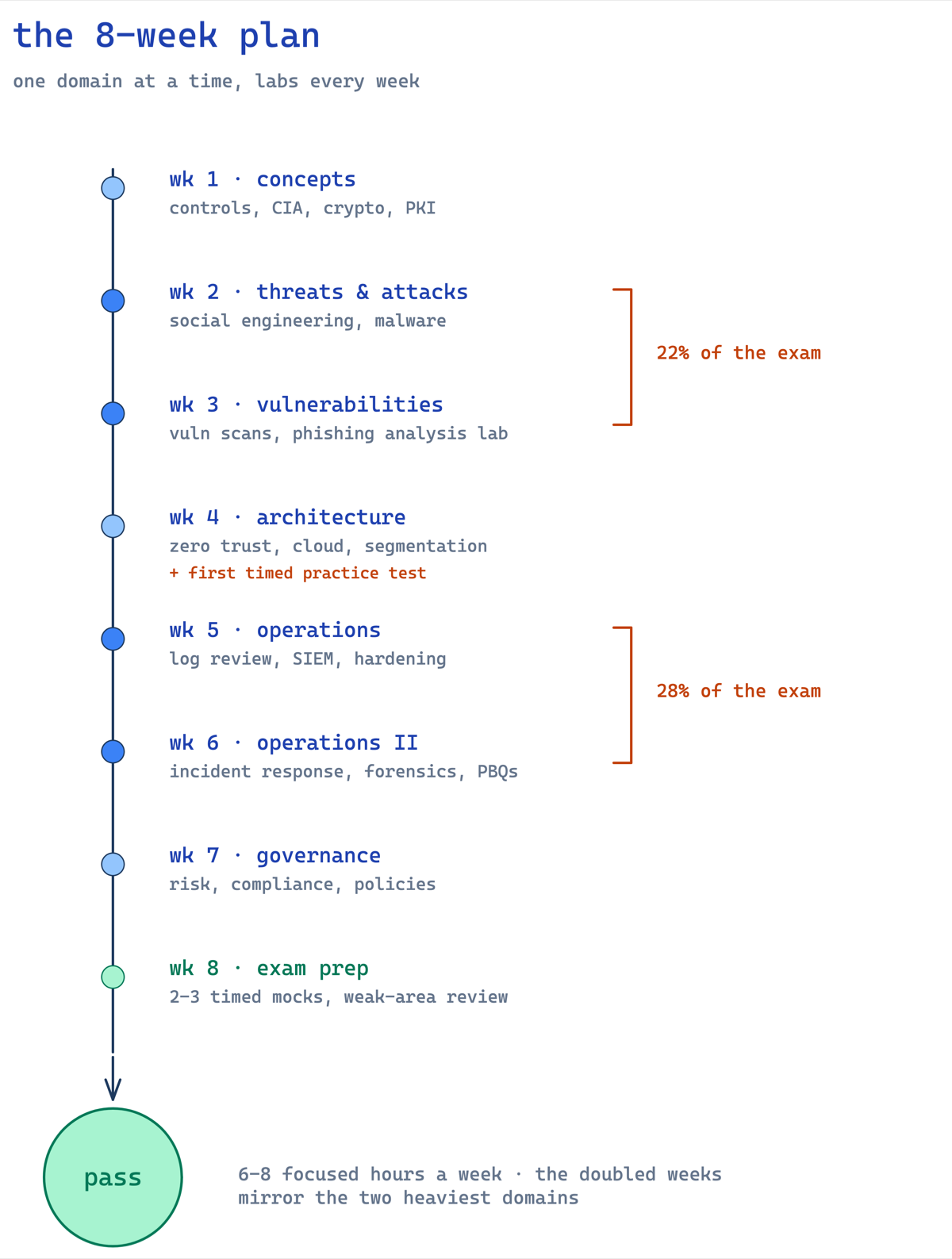
Week 1: General Security Concepts
Learn the vocabulary the rest of the exam is written in: control categories and types, CIA, AAA, zero trust, and cryptography basics through PKI. Start your acronym list now and add to it daily. Security+ is the most acronym-dense exam CompTIA writes.
Weeks 2-3: Threats, Vulnerabilities, and Mitigations
Two full weeks for the second-biggest domain. Cover threat actors and social engineering in week 2, then vulnerabilities, malware, and attack types in week 3. Lab it: run a vulnerability scan against a test VM, and walk through real phishing emails header by header.
Week 4: Security Architecture
Zero trust, segmentation, cloud models, and data protection. At the end of this week, sit your first full timed practice test. You will not be ready, and that is the point: the score tells you where the next four weeks should focus, and you get to see the question style with half the material still to come.
Weeks 5-6: Security Operations
The 28% domain gets two weeks, and it is the most hands-on: hardening checklists, log review, SIEM alerts, identity and access management, and the incident response lifecycle (preparation, detection, analysis, containment, eradication, recovery, lessons learned). Memorize that order; the exam loves asking what comes FIRST or NEXT.
Week 7: Governance, Risk, and Compliance
The domain most self-taught candidates skip, and it is a fifth of the exam. Risk register terms, third-party risk, compliance frameworks, audits, and awareness programs. It is memorization-heavy, which makes it efficient marks for a focused week.
Week 8: Practice Exams and Review
Two or three full timed mocks under exam conditions. Review every wrong answer and every lucky guess, then spend the final days re-drilling your weakest domain and your acronym list.
How to Handle PBQs
Expect three to five performance-based questions at the start of the exam: drag-and-drop matching, ordering firewall rules, reading logs to identify an attack. Two rules protect your score:
- Do not burn your clock on them first. Skim each PBQ, flag it, answer all the multiple-choice questions, then come back. A PBQ is worth more than one question, but it is not worth ten minutes of panic.
- Practice them before exam day. PBQs simulate doing the work, so prepare by doing the work: review real logs, classify real phishing attempts, and build firewall rules in a lab, the same exercises CISNET runs in class.
Common Mistakes to Avoid
- Equal time per chapter. The domains are weighted 12% to 28%; your calendar should be too.
- Skipping governance. Domain 5 alone can swing a pass to a fail, and it is the easiest domain to score with pure study.
- No timed practice until the end. Your first mock belongs at week 4, not the night before.
- Memorizing definitions without scenarios. The exam asks BEST, FIRST, and MOST LIKELY. If you cannot apply a term inside a story, you do not know it yet.
- Ignoring the acronym wall. SIEM, SOAR, EDR, DLP, IAM, PKI, and dozens more. Build the list from week 1 and review it every session.
What Happens After You Pass
Security+ is valid for three years and renews with 50 continuing education units or by passing a higher-level exam like CySA+. In Canada it is recognised by the federal government and meets US DoD 8570 baselines, which is why it appears as a hard requirement in so many SOC and analyst postings. Canadian SOC and security analyst roles that list it typically start at CAD $70-90K; see our IT certification salary report for current ranges.
From here, the common next steps are CySA+ for blue-team depth, or pairing Security+ with the CCNA for network security roles. For the longer view of where the certification leads, read our cybersecurity career path guide.
Ready to Start?
CISNET's Security+ course is 30 hours of live online, instructor-led training mapped to the five SY0-701 domains, with hands-on labs for exactly the skills the PBQs test: phishing analysis, log review, vulnerability scanning, and incident response. Every seat includes full practice exams and one-on-one exam prep; see upcoming cohort dates or start with the full Security+ certification guide.
Frequently Asked Questions
How long does it take to study for Security+?
Six to eight weeks at 6-8 focused hours a week is realistic for someone with basic IT familiarity, roughly 40-60 total hours. Complete beginners should add two to four weeks of networking and operating system fundamentals before starting the plan.
Do I need Network+ or work experience before Security+?
No. Security+ has no formal prerequisites. CompTIA recommends Network+ level knowledge and two years of IT experience, but motivated beginners pass regularly. If ports, protocols, and IP addressing are new to you, review networking basics first; our OSI vs TCP/IP guide is the right starting point.
How much does the Security+ exam cost?
The SY0-701 exam voucher costs USD $404 from CompTIA. Training is separate; see the Security+ course page for current CISNET pricing and what every seat includes.
Is Security+ enough to get a job in Canada?
For entry-level SOC analyst, security analyst, and security-focused IT support roles, yes. It is the baseline credential Canadian postings name most often, and it carries more weight when you can demonstrate the hands-on skills behind it: log review, phishing analysis, and a documented home lab. Combined with interview preparation, it is the strongest single entry credential in Canadian cybersecurity.


