
Zero Trust Architecture: Tenets and the Two Planes

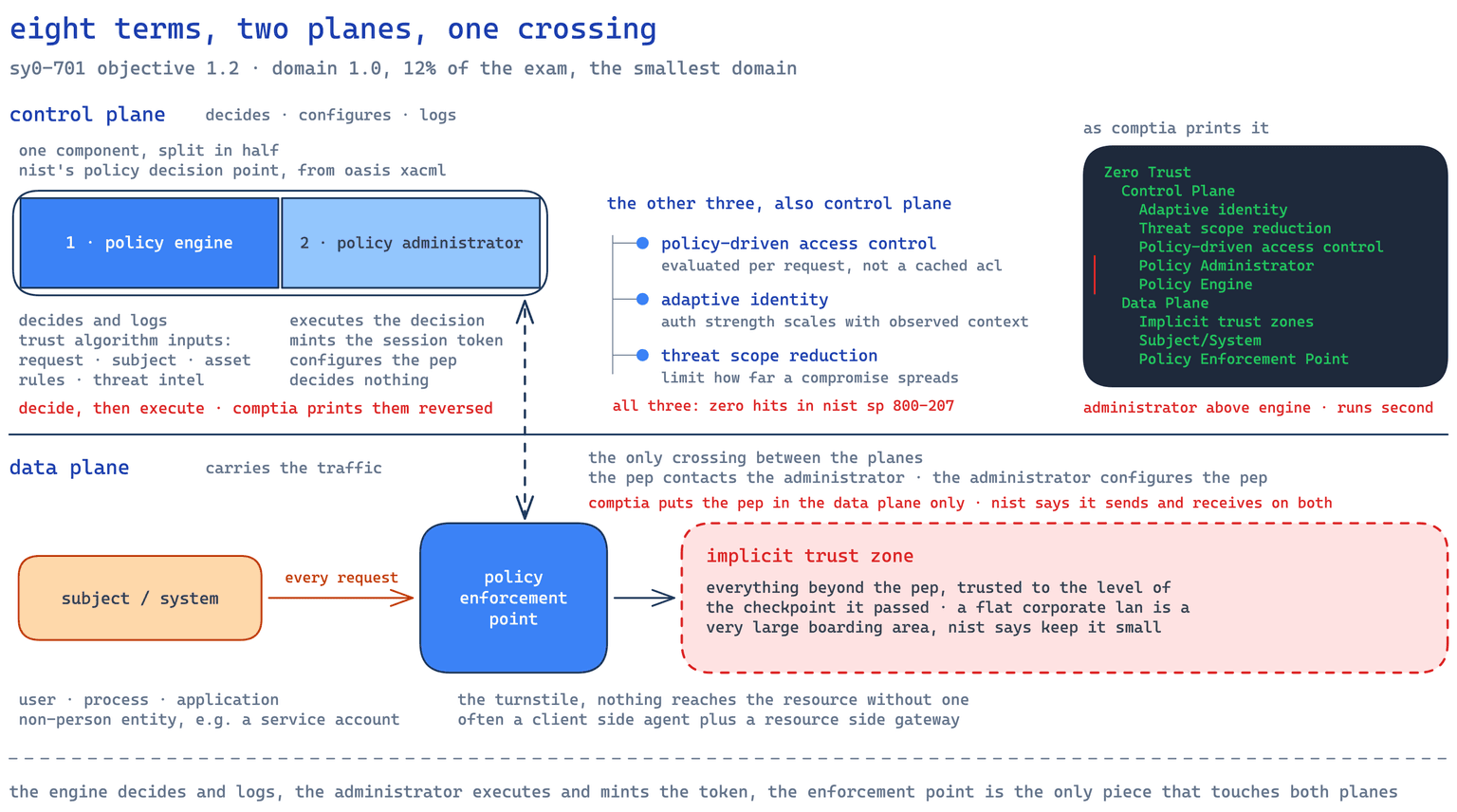
Zero Trust is a security architecture that assumes the network is already compromised and authorises every request on its own merits instead of trusting anything because of where it sits. NIST splits the machinery into a control plane that decides and a data plane that carries traffic, and CompTIA Security+ SY0-701 tests eight terms spread across that split.
Key takeaways
- Zero Trust removes implicit trust from network location: every request is evaluated per session against dynamic policy.
- NIST SP 800-207 is the authoritative source: seven tenets and two planes. The control plane decides and configures, the data plane moves the traffic.
- The Policy Engine decides and logs. The Policy Administrator executes that decision and mints the session token. CompTIA prints the pair in the opposite order.
- CISA's Zero Trust Maturity Model v2.0 scores five pillars: Identity, Devices, Networks, Applications and Workloads, and Data.
- On Security+, Zero Trust sits in objective 1.2, inside Domain 1.0, which is 12% of the exam. SY0-701 English retires June 11, 2027.
I have taught this topic in every Security+ cohort CISNET has run, and the answer goes wrong in the same place every time. Candidates memorise CompTIA's bullet list in its printed order, and that order is misleading: the objectives put Policy Administrator above Policy Engine, the reverse of how the mechanism runs. When I put a denied access request on the board and ask which component made that call, the students who answer Policy Administrator are the ones who learned the list instead of the flow. Under exam pressure that inversion costs the mark.
Exam facts: where Zero Trust sits in Security+ SY0-701
| Exam fact | Detail |
|---|---|
| Objective | 1.2, "Summarize fundamental security concepts" |
| Domain | 1.0 General Security Concepts |
| Domain weight | 12% of the exam, the smallest domain |
| Appearances | Once. Not repeated in Domain 3 |
| Terms listed | Eight, split across Control Plane and Data Plane |
| Retirement | English June 11, 2027. Japanese, Portuguese, Spanish and Thai August 13, 2027 |
That one bullet still earns a study session: those eight sub-terms become scenario items.
What Zero Trust actually means, in NIST's words
The authoritative definition is NIST SP 800-207, published August 2020 and still marked FINAL.
Zero trust (ZT) provides a collection of concepts and ideas designed to minimize uncertainty in enforcing accurate, least privilege per-request access decisions in information systems and services in the face of a network viewed as compromised.
Read the last clause twice: a network viewed as compromised. That assumption is the model, the rest is plumbing.
John Kindervag introduced the model at Forrester on September 14, 2010, in No More Chewy Centers, on three concepts: verify and secure all resources, strictly enforce access control, and inspect and log all traffic.
One correction to carry into the exam. "Never trust, always verify" is a paraphrase, not a quotation. Search NIST SP 800-207 and the slogan returns zero hits; the document says trust "is never granted implicitly but must be continually evaluated".
The seven tenets of Zero Trust
NIST SP 800-207 Section 2.1 lists seven tenets. They are the design rules an architecture must satisfy before anyone can honestly call it Zero Trust.
- All data sources and computing services are treated as resources, including personal devices and cloud services the enterprise does not own.
- All communication is secured regardless of network location. Being inside the building earns no trust and no exemption.
- Access to individual enterprise resources is granted on a per-session basis, with the least privilege needed for the task.
- Access is determined by dynamic policy, evaluated against observable client identity, the application or service, the requesting asset, and behavioural and environmental attributes.
- The enterprise monitors and measures the integrity and security posture of every owned and associated asset. No asset is inherently trusted.
- All resource authentication and authorisation are dynamic and strictly enforced before access is allowed, as a loop of access, scanning, reassessing and re-authenticating.
- The enterprise collects as much information as it can about the current state of assets, infrastructure and communications, and feeds it back into improving its security posture.
Tenets 3, 4 and 6 separate Zero Trust from a well segmented traditional network.
Why the castle and moat model failed
Kindervag's metaphor for the perimeter model was an M&M: a hard shell around a soft centre. The data agrees. The 2026 Verizon DBIR examined more than 31,000 real world incidents across 145 countries. Exploitation of vulnerabilities is now the top initial access vector at 31%, up from 20%, while credential abuse, the previous leader, fell to 13%. None of that describes an attacker stopped at the moat, and NIST calls unauthorised lateral movement one of the biggest challenges for federal agencies. Our guide to common attack types covers those vectors.
Implicit trust zones explained
NIST explains it with an airport. Passengers clear one checkpoint, and the boarding area beyond trusts everyone to the level of that gateway. A flat corporate LAN is a very large boarding area, so NIST's rule is to keep it as small as possible.
CompTIA reads this differently. SY0-701 lists implicit trust zones under the Data Plane; NIST treats them as residual over-trust to shrink. Answer on the objective's placement, work to NIST's intent.
Control plane and data plane in Zero Trust
NIST Section 3.4 defines both. The control plane configures assets, grants or denies access and sets up communication paths. The data plane carries the traffic, which may not be possible until the control plane has built the path.
One fact makes the objective click: the Policy Engine and Policy Administrator are one component split in half. NIST takes the policy decision point, inherited from OASIS XACML, and names the deciding and acting halves separately.
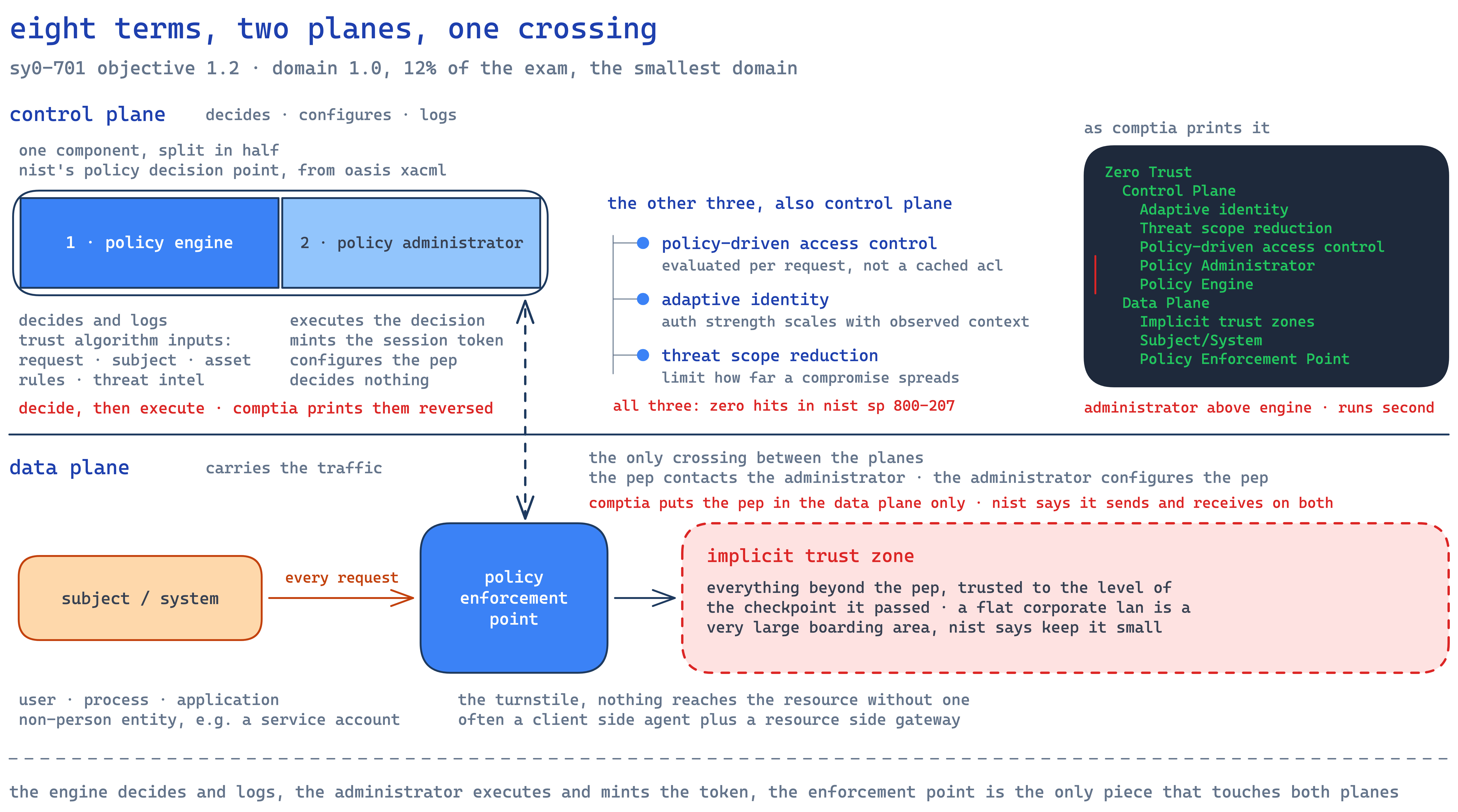
Note the dashed line. CompTIA places the enforcement point in the data plane only, while NIST states that PEPs send and receive on both planes.
How one Zero Trust request flows end to end
- A Subject or System requests a resource: a user, a process, or a non-person entity such as a service account.
- The request reaches a Policy Enforcement Point. Nothing reaches the resource without passing one.
- The PEP forwards it to the Policy Administrator over the control plane.
- The Policy Engine evaluates it against enterprise policy using its trust algorithm.
- The Policy Engine grants, denies or revokes, and logs the decision.
- The Policy Administrator executes it, minting the session token and configuring the PEP.
- The PEP opens the data plane path, and tears it down if the approval is revoked.
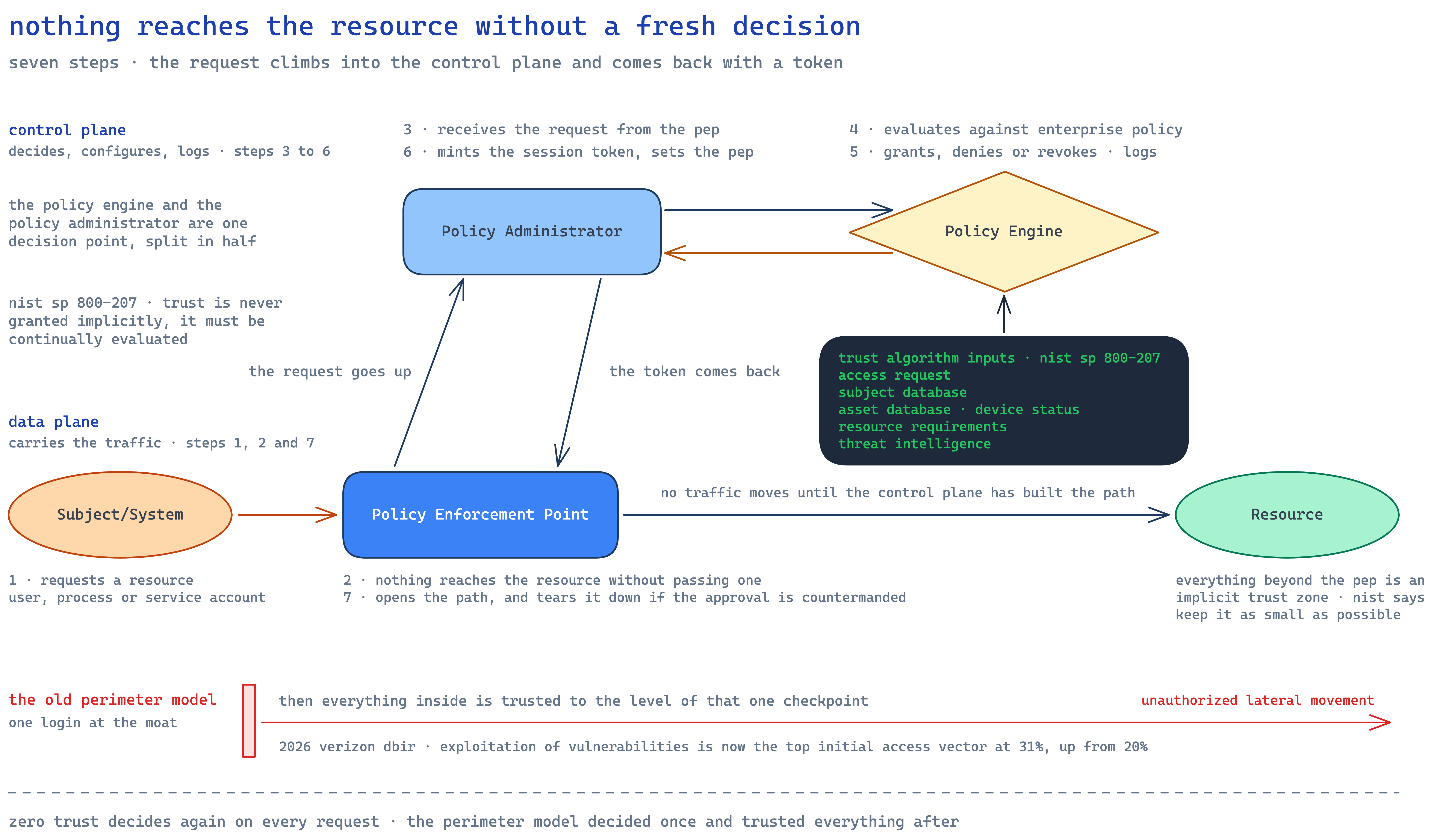
Steps 3 to 6 are control plane, steps 1, 2 and 7 are data plane. Scenario questions test exactly that split.
The eight SY0-701 Zero Trust terms, defined
| Term | Plane | One line role |
|---|---|---|
| Policy Engine | Control | Decides and logs the access decision |
| Policy Administrator | Control | Executes the decision, mints the session token |
| Policy-driven access control | Control | Policy evaluated per request, not cached |
| Adaptive identity | Control | Authentication strength scales with context |
| Threat scope reduction | Control | Limits how far a compromise can spread |
| Subject/System | Data | The requester of the resource |
| Policy Enforcement Point | Data | The turnstile that opens and closes the path |
| Implicit trust zones | Data | Whatever sits beyond the enforcement point |
Policy Engine. The decision maker, fed by five trust algorithm inputs: the access request, the subject database, the asset database with device status, resource requirements, and threat intelligence.
Policy Administrator. The executor. It opens or shuts the path, mints the session credential, instructs the PEP. It decides nothing.
Policy-driven access control. Access evaluated per request against dynamic policy, not a static ACL cached once.
Adaptive identity. Authentication strength scales with observed context: device posture, geolocation, time of day, connection type, prior behaviour.
Threat scope reduction. CompTIA's name for limiting how far a compromise spreads. CISA's version is the protect surface: each segment covers a smaller, well defined piece of the enterprise.
Subject/System. The requester: users, processes, applications, and non-person entities.
Policy Enforcement Point. One logical component, often split into a client side agent and a resource side gateway. It is not simply the firewall: CISA says PEPs can operate at any OSI layer, and several may participate in one decision.
Implicit trust zones. Whatever lies beyond the PEP.
Be honest about provenance, because this is where blogs fabricate. Adaptive identity, threat scope reduction and policy-driven access control each return zero hits in NIST SP 800-207. They are CompTIA vocabulary, not NIST's.
When I mark practice scenarios, the wrong answers rarely come from a bad definition. Students describe adaptive identity perfectly, then file it under the data plane because it sounds like something happening to a user. The plane is the tested axis, so drill the bucket, not the wording.
Microsegmentation vs traditional segmentation
SY0-701 never uses the word microsegmentation. The objectives say Segmentation in 2.5, 3.3 and 4.3, plus Logical segmentation, Physical isolation, Air-gapped and Software-defined networking in 3.1, and neither ZTA nor ZTNA is in the acronym appendix, which you can check against our Security+ acronym list.
CISA's July 2025 guidance calls it a design philosophy focused on minimising segment size, to limit lateral movement from a compromised endpoint.
| Dimension | Traditional segmentation | Zero Trust microsegmentation |
|---|---|---|
| Policy written against | IP ranges, VLANs, static rules | identity, device posture, workload, context |
| Enforcement lives at | a few routed chokepoints | host, application, database or hypervisor |
| Rule lifecycle | static, changed by ticket | dynamic, per request |
If your segmentation knowledge stops at VLANs, read our guide to VLANs first. NIST names three routes to Zero Trust: enhanced identity governance, logical micro-segmentation, and network based segmentation, which Section 3.1.3 calls network infrastructure and software defined perimeters. A full ZT solution uses all three.
ZTA and ZTNA are not the same thing
Zero Trust Architecture is the whole enterprise design: tenets, planes and policy components, applied across identity, devices, networks, applications and data. Zero Trust Network Access is one product category inside it, aimed at remote and third party access. A ZTNA broker verifies the user and the device, then connects that session to one named application rather than placing the client on the network the way a VPN does.
The practical difference is blast radius. A VPN says "you are on the network now". ZTNA says "you may reach this one application for this one session".
How to adopt Zero Trust: CISA's four phases and five pillars
CISA publishes a four phase method and stresses these are not one time tasks.
- Identify candidate resources. Early on prioritise ease of transition, later prioritise high value assets.
- Identify dependencies for those resources, with the stakeholders who own them. Mapping which service answers on which port is the unglamorous half; our ports reference is the fastest way through it.
- Determine segmentation policies, with affected users in the loop.
- Deploy in a permissive mode that flags violations first, so missed dependencies surface before they break production.
Phase 4 is the one organisations skip, and in twenty years of enterprise network work I have never seen that end well. The dependency you miss is rarely the application traffic everyone documented. It is the management traffic nobody owns: backup agents, monitoring pollers, directory replication, the jump host an admin built years ago. Run permissive long enough to cover a full monthly cycle before you switch a segment to enforce.
Measure progress with CISA's Zero Trust Maturity Model v2.0. It scores five pillars, Identity, Devices, Networks, Applications and Workloads, and Data, against four maturity stages: Traditional, Initial, Advanced and Optimal, with visibility and analytics, automation and orchestration, and governance assessed across all five.
What Zero Trust does not fix
Anyone with rule access to the engine or administrator can break the enterprise quietly, and denial of service against the PA or PEP makes the decision infrastructure a single point of failure. NIST is blunt that an attacker with valid credentials still reaches whatever the account was granted. Zero Trust does not stop credential theft. It stops the move after it.
Where this fits in your Security+ prep
Zero Trust opens module 2, Security Architecture and Design, of CISNET's live instructor led Security+ course, followed by segmentation and DMZ design. For the domain breakdown and exam logistics, start with our Security+ study guide; our cybersecurity career path guide shows where the certification leads.
Sources
- NIST SP 800-207, Zero Trust Architecture, August 2020. Definition Section 2, tenets Section 2.1, deployment approaches Section 3.1, planes Section 3.4.
- CISA Zero Trust Maturity Model v2.0 and CISA microsegmentation guidance, July 2025.
- Verizon Data Breach Investigations Report, 2026 edition.
- CompTIA Security+ SY0-701 exam objectives and retirement notice.
Frequently Asked Questions
What is Zero Trust architecture in simple terms?
Zero Trust is a security architecture that grants no access based on network location. Every request from a user, device or service is authenticated, authorised and evaluated against dynamic policy per session, on the assumption that the network is already compromised. NIST SP 800-207 is the authoritative definition, and it splits the machinery into a control plane that decides and a data plane that carries traffic.
What are the seven tenets of Zero Trust?
NIST SP 800-207 Section 2.1 lists seven: treat all data sources and services as resources; secure all communication regardless of network location; grant access per session; determine access by dynamic policy; monitor the integrity and posture of every asset; enforce authentication and authorisation dynamically before access; and collect as much state information as possible to improve security posture.
Is Zero Trust on the CompTIA Security+ SY0-701 exam?
Yes. Zero Trust is tested under objective 1.2, "Summarize fundamental security concepts", in Domain 1.0 General Security Concepts, which is 12% of the exam, the smallest domain. It appears exactly once, listing eight sub-terms split across a control plane and a data plane.
What is the difference between the control plane and the data plane in Zero Trust?
The control plane makes access decisions and configures paths, holding the Policy Engine and Policy Administrator. The data plane carries traffic between subject and resource once the path is authorised. SY0-701 puts the Policy Enforcement Point in the data plane, though NIST says a PEP sends and receives on both.
What is the difference between a policy engine and a policy administrator?
The Policy Engine makes and logs the access decision, using enterprise policy plus a trust algorithm fed by the request, the subject and asset databases and threat intelligence. The Policy Administrator then executes it, minting the session token and telling the Policy Enforcement Point to open the connection. CompTIA lists the Administrator first, the reverse of the real sequence.
What is the difference between ZTA and ZTNA?
Zero Trust Architecture is the full enterprise design covering identity, devices, networks, applications and data. Zero Trust Network Access is a product category within it that brokers remote access: it verifies the user and device, then connects the session to one named application instead of placing the client on the network as a VPN does. ZTNA is a component of a ZTA, not a replacement for one.
Is microsegmentation tested on Security+ SY0-701?
Not by that name. The objectives never use the word microsegmentation. They say Segmentation in objectives 2.5, 3.3 and 4.3, plus Logical segmentation, Physical isolation and Software-defined networking in 3.1, so expect exam items to say segmentation.
Does Zero Trust replace VPNs and firewalls?
No. Zero Trust is an architectural approach, not a product you can buy and not a rip and replace of existing controls. NIST keeps perimeter devices in its reference architecture and CISA frames Zero Trust as a journey through maturity stages. What changes is that network location alone no longer grants trust.


